
Candice Callaway is a vital part of the team at Eyecare Associates. In addition to managing insurance and billing, she is also one of our vision therapy coordinators. Candice has worked at Eyecare Associates for five years after previous experience with in the medical field.
Candice lives in the BCLUW Community school district with her husband, Blake, and their two children, Emily and Aydien. In her free time, Candice enjoys being crafty and spending time with her family.
If these symptoms apply to you, or someone you know, schedule an appointment today!
Our eyes have an automatic focusing system which adjusts the lens inside our eye in order to see clearly at all distances. When we look far away, up close, and back again, our eyes change focus rapidly to allow us to see things clearly at all distances. If there is a problem in how easily or quickly our eyes focus, that visual problem is called an accommodative dysfunction.
Normally, children have a large amount of focusing capacity. However, some children do not have the ability to maintain focus for a long time while reading, or they may be unable to quickly change the focus of their eyes from near to distance to near, etc.
In some cases, glasses for near use only, or in special bifocal form, may be needed. Improved focusing ability can usually be developed with a program of Vision Therapy.
Adults can also have Accommodative Dysfunction. However, this is not to be confused with a very common visual condition called presbyopia. Presbyopia is the term for age-related focusing problems. In adults, age-related focusing problems are due to loss of the natural elasticity of the lens inside the eyes. As we age, the focusing lenses become less flexible, and we begin to experience blurred vision at close distances.
See the box to the left for common symptoms of accommodative dysfunction.
*This article was taken from the College of Optometrists in Vision Development. The original article and references can be found at covd.org
According to Madelyn’s mother, “When Madelyn had her yearly eye exam we mentioned that she was having frequent headaches. Dr. Edwards completed her exam and mentioned the need to do more tests, but was thinking Madelyn needed vision therapy.”
When Dr. Monroe saw Madelyn, she found that Madelyn had reduced convergence ability – which is the skill necessary for her eyes to point in the same place while reading.
Because Madelyn’s convergence ability was so poor, she was having double vision, blurry vision, and headaches with reading. Her mother says, “After vision therapy, she has greatly reduced the headaches she gets. Madelyn shares that she does not see double when she reads and has made great progress.”
Madelyn’s convergence and focusing abilities of her eyes are now functioning within the normal range for her age. Homework that used to take Madelyn 40 minutes to complete is now done in 20 minutes. Way to go Madelyn! We are proud of your hard work and success.
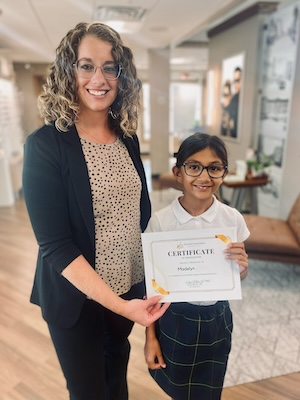
Rachel Brodin wears many hats at Eyecare Associates. She is one of our office’s Chief Encouragement Officers (CEOs) in addition to being our Vision Therapy Coordinator. Rachel has worked at Eyecare Associates for six years after graduating from University of Northern Iowa in Cedar Falls.
Rachel enjoys being involved in vision therapy. After observing her first vision therapy session, Rachel was excited to learn more about vision therapy and is always amazed at how the process works. Her favorite part is hearing the success stories and seeing patients improve and build their confidence.
Rachel lives in Marshalltown with her husband, Matt, who works as a realtor at Premier Real Estate. Their family also includes two dogs, a cat, and their adorable baby, Theo. Rachel loves to travel, especially anywhere related to Disney.

Many people think that vision therapy is only for children. However, adults have as much need for this type of vision care as children. Vision therapy is often effective for adults because they are motivated to improve their visual abilities.
When people have trouble using both eyes together or can’t focus for great lengths of time, they do not simply grow out of these problems. Children with visual problems often become adults with visual problems.
Adults will figure out many ways to compensate for their visual problems so that they can continue with any strenuous visual work they need to do. Often, adults come home from work extremely tired when all they did was sit at a desk and do paperwork. Some people will feel as if they had just run a 10K race! Children, on the other hand, will tend to avoid tasks that are difficult or make them feel inadequate.
A developmental optometrist can help to reduce the strain of near work as well as work with any other kinds of visual problems. The proper lenses along with vision therapy make a tremendous difference in an adult’s ability to function at work or sports, just as with children of school age. Clinical results have shown that in-office vision therapy produces statistically significant improvement in vision symptoms for adults.
*This article was taken from the College of Optometrists in Vision Development. The original article and references can be found at covd.org
According to the mother of one of our recent vision therapy graduates, “Her headaches have improved. Reading has improved significantly. Her confidence has increased. Definitely recommend.” This 4th grader says, “Vision therapy has helped me improve my reading and my reading stamina. Also vision therapy has helped me have not that much of blurry vision.”
Before vision therapy, this recent graduate had trouble accurately moving her eyes together. Using our RightEye infrared eye tracking device, we compared her eye movement abilities to other kids her age. Before vision therapy, her performance was significantly below average, in the 19th percentile. After vision therapy, her eye movement skills improved to the 72nd percentile! No wonder she is becoming a confident reader! Congratulations!
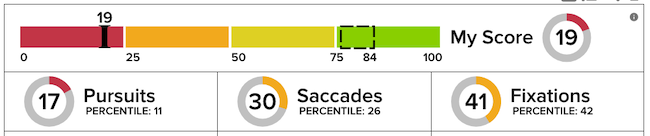
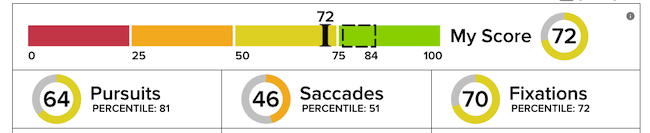
Click to view full-sized
At Eyecare Associates, we always try to be at the forefront of technology. We are excited to have the RightEye Vision System in our office. This computerized, infrared eye tracking device allows us to measure the dynamic vision skills that impact the quality of your life.
Functional vision is how well the eyes and the brain work together to process what is seen, and this essential aspect of vision isn’t always evaluated in a traditional eye exam. When your dynamic visual skills aren’t addressed, it can negatively impact your everyday life, including activities such as driving, reading, having good balance and coordination or playing a sport.
Through a quick assessment, the RightEye is able to:
What is convergence insufficiency (CI)? Convergence insufficiency is a common, yet not frequently diagnosed eye condition that affects how the eyes work together when reading or doing close work.
Convergence insufficiency affects up to 13% of people – that’s 1 in every 8 kids and adults!
Kids and adults can have CI and not even realize it! Here are some of the common symptoms:
The good news is that if you or someone you know is diagnosed with convergence insufficiency, it is treatable! Both the American Optometric Association and the Convergence Insufficiency Treatment Trial clearly indicate that office-based vision therapy supplemented by at-home activities assigned by a doctor are the best treatment for CI.
If you recognize some of these symptoms, the first step is scheduling a comprehensive eye examination. Schedule an appointment today.
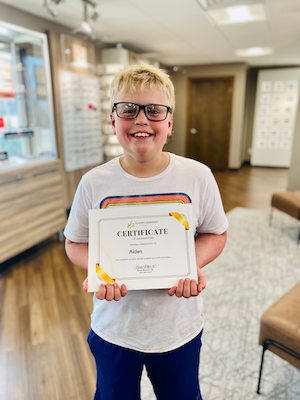
Aiden was 8 years old when he reported some blurry and double vision at his regular eye examination with Dr. Chadderdon at Eyecare Associates. Dr. Chadderdon realized that this was related to a condition called convergence insufficiency, which impacted how Aiden’s eyes worked together. Aiden started vision therapy with Dr. Monroe and was making good progress to reduce his double vision when an unfortunate ATV accident sent Aiden to University of Iowa Children’s Hospital with multiple injuries including skull fractures and a type of a brain injury called a diffuse axonal injury. With excellent medical care and support from his family, Aiden was able to recover from his injuries. As he returned to school, Aiden also returned to vision therapy. While his accident had increased some of his symptoms and slowed his progress a bit, Aiden kept a positive attitude.
Aiden recently graduated from vision therapy, and is doing great. Prior to vision therapy, Aiden saw double vision when he was reading most of the time and reported that he lost concentration while reading leading him to have trouble remembering what he read. At the conclusion of vision therapy, Aiden was happy to report that he no longer had any double vision when reading, and it is much easier for him to stay focused and remember what he reads. He has also significantly improved his reading speed at school. Way to go Aiden!
Just like Aiden, many people don’t realize that vision could be the cause of their struggles. If you or someone you know isn’t performing up to their potential, take the symptom quiz by or schedule an appointment. Vision might be the key to unlocking their full potential!
Studies suggest that as many as one in 10 school-age children may have a vision problem that is significant enough to affect learning. Most people assume that if kids pass a vision screening at the pediatrician or at school, their vision must be fine. However, there are many different visual skills required for academic success.
Having 20/20 vision isn’t enough. 20/20 measures how small someone can see, but doesn’t assess other skills needed such as: focusing, eye teaming (binocular vision), coordinated eye movements, or tracking ability.
Up to 80% of a child’s learning in school is through vision!
Many kids and adults with vision problems can be misdiagnosed with ADD/ADHD or other learning disabilities because they often:
If you recognize some of these symptoms, the first step is scheduling a comprehensive eye examination. Schedule an appointment today.
Struggling in School
Skipping Lines when reading
Eyes hurt or feel tired
Did you know these symptoms (and many others) could be a sign of a vision problem? Just like our 14 year old vision therapy graduate, many people don’t realize that vision could be the cause of their struggles. Kids often don’t realize it isn’t normal for words to be blurry or move around on the page while reading.
If you or someone you know isn’t performing up to their potential, take the symptom quiz by or schedule an appointment. Vision might be the key to unlocking their full potential!
Visit bit.ly/symptomquiz to take the symptom quiz.
© All rights Reserved
Accessibility Statement - Privacy Policy - Terms and Conditions - Sitemap
Managed and Designed by