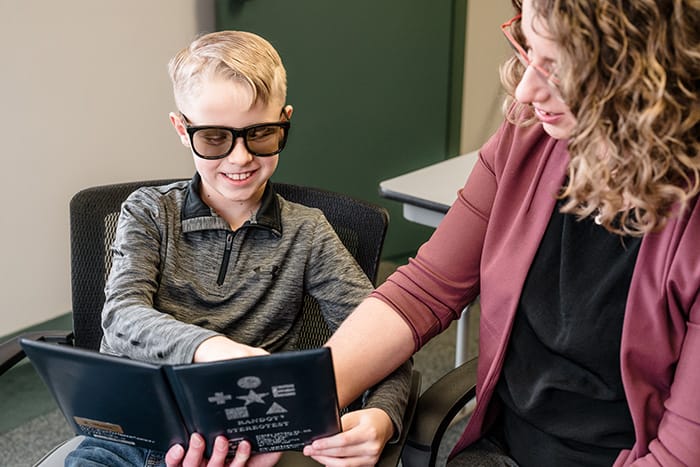
Vision Therapy is a behavioral approach to correcting various eye problems that affect one’s ability to receive and process visual information. A person may have “perfect” vision while reading an eye chart, pass a vision screening by reading 20/20, and still have developmental vision problems. The areas most often affected are focusing, eye teaming, eye movements and visual processing.
Vision Therapy is an individualized treatment program designed to improve and sometimes eliminate conditions such as lazy eye (amblyopia), crossed eyes (strabismus), focusing insufficiency and excess, ocular muscle dysfunction, and learning-related vision disorders. Specialized lenses, filters, prisms and instruments are used in a training program, which is customized for each patient.
Unlike self-directed programs of “eye exercises” marketed to the public, in-office optometric vision therapy is conducted under the supervision of an optometrist and supported by ongoing, evidence-based scientific research.
The goal of optometric vision therapy (“VT”) is not to strengthen eye muscles. Your eye muscles are already incredibly strong, and the vision problems VT aims to treat are rarely caused by muscle weakness. Instead, vision therapy aims to retrain the learned aspects of vision through the recently-understood concept of neuroplasticity.
It is estimated that 1 in 10 children have a vision problem severe enough to affect their learning in school, but school vision screenings can miss up to half of these problems. A comprehensive vision exam with a developmental optometrist checks all aspects of eye health, vision, and visual skills, and can ensure you or your child is not struggling unnecessarily with an undiagnosed vision problem.
© All rights Reserved
Accessibility Statement - Privacy Policy - Terms and Conditions - Sitemap
Managed and Designed by